Underfloor Heating · Blackheath & South East London

Underfloor Heating
Installation in
South East London

Wet system underfloor heating for ground-floor extensions, open-plan kitchens, and modern house transformations across SE London. Hydraulic balancing performed post-installation to guarantee even, consistent radiant heat throughout.

Gas Safe Registered Over 60 Years Trading Third-Generation Family Business Fully Insured

What Underfloor Heating Installation from R G Austin Actually Involves

A wet underfloor heating installation typically spans three to six working days in a domestic property, depending on the floor area being treated, the condition of the existing subfloor, and whether structural screeding is required as part of the build-up. The timeline is established during the site visit once we have assessed the specific floor construction.

The starting point of every underfloor heating job is a thorough subfloor evaluation. The construction of the floor — whether it is a suspended timber ground floor, a solid concrete slab, or a beam-and-block extension base — determines both the pipe-laying method and the required insulation build-up depth. Insufficient insulation depth is the primary cause of poor underfloor heating performance: heat that conducts downward rather than upward into the living space wastes energy and never delivers the ambient warmth that makes UFH worthwhile.

Boiler output capacity is assessed at the same stage. Adding a wet UFH zone to an existing heating system increases the circuit's demand. An undersized boiler, or one already operating at near-capacity with the existing radiator circuit, will fail to meet the combined load. Where the existing boiler is not suitable, we identify this during the site survey and discuss the options — including whether a new boiler installation is required concurrently or whether the UFH zone can be isolated to periods when the radiator circuit is not in full demand.

The pipework is laid in a serpentine pattern within the insulation layer, with individual zone manifolds controlling flow to different areas of the floor. Pipe spacing is calculated to achieve the target surface temperature across the full zone rather than concentrating heat at the manifold end. Following installation and pressure-testing of all pipe circuits, the floor is screeded and allowed to cure before the system is commissioned.

Hydraulic balancing is performed as a final step after the screed has reached thermal equilibrium. This process equalises flow rates through each circuit so that every part of the heated floor reaches the same surface temperature. A system that is not hydraulically balanced will produce warm patches near the manifold and cooler areas at the circuit extremities — a common outcome when this step is omitted or rushed.

  • Subfloor evaluation and insulation depth specification prior to installation
  • Boiler output capacity assessment for UFH zone compatibility
  • Serpentine pipe layout with calculated spacing for even surface temperature
  • Full pressure testing of all pipe circuits before screeding
  • Hydraulic balancing on commissioning for perfectly even heat distribution
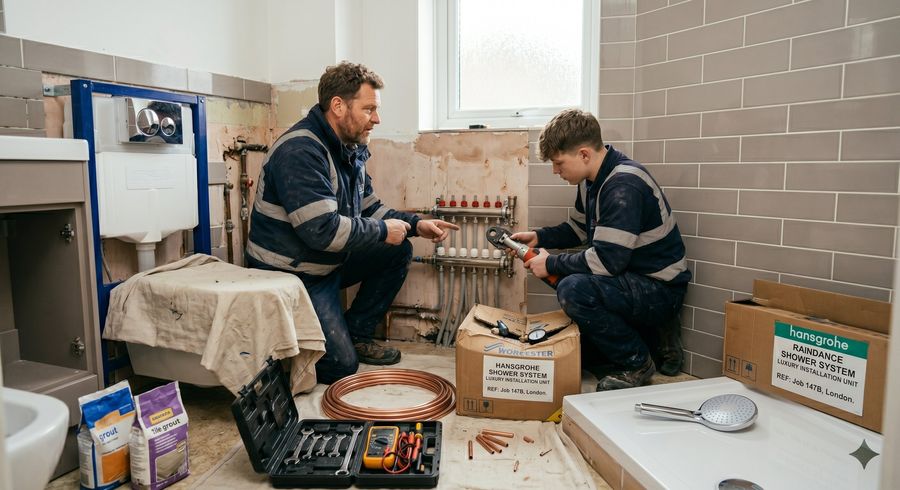
R G Austin Ltd engineers fitting an underfloor heating manifold system during a bathroom renovation in London

From Site Assessment to
Commissioned, Balanced System

Initial Call & Project Discussion

You describe the space — a ground-floor extension, a kitchen, or an open-plan area — and its approximate floor area. We discuss the floor construction, the existing heating system, and the intended floor finish, as these all influence the UFH specification. We book a free site visit to complete the assessment in person.

Site Assessment — Subfloor, Insulation & Boiler Capacity

Jonathon or Jack Austin attends and assesses the existing subfloor construction, establishes the required insulation build-up depth, and evaluates whether the existing boiler can support the additional UFH zone load. A fixed-price written proposal is provided within 24 to 48 hours covering the full installation scope.

Insulation Layer & Pipe Installation

Insulation boards are laid to the specified depth across the floor area. The UFH pipework is installed in a calculated serpentine pattern with consistent spacing, fixed securely to the insulation and connected to the zone manifold. Each circuit is pressure-tested individually before the floor is closed. The manifold is connected to the boiler circuit and zone controls installed.

Screeding & Cure Period

Where a screed build-up is required — on solid floors or beam-and-block bases — the screed is applied over the pipe array and allowed to cure to the manufacturer's specified timeline. During this period the system is run at a low temperature and gradually brought up to working temperature over several days, preventing thermal shock cracking of the screed during curing.

Hydraulic Balancing, Commissioning & Handover

With the screed at thermal equilibrium, the system is commissioned and hydraulic balancing is performed across all circuits. Flow rates through each loop are adjusted until surface temperatures are consistent across the full floor area. We walk you through the zone controls and thermostat, and confirm the system is performing to specification before leaving.

What Is & Isn't Included in a Standard
Underfloor Heating Installation

Typically Included

  • Subfloor evaluation and insulation depth specification
  • Insulation board supply and installation
  • UFH pipework supply and installation in calculated layout
  • Zone manifold supply, installation, and connection
  • Pressure testing of all circuits prior to screeding
  • Connection to existing boiler circuit and zone controls
  • Hydraulic balancing post-commissioning
  • Full controls and thermostat setup and handover

What May Fall Outside Standard Scope

  • Structural screeding where required — this is identified during the site assessment and included in the fixed-price proposal if applicable
  • Boiler replacement where the existing unit cannot support the additional UFH zone load — assessed and priced separately
  • Electrical work for smart thermostat installation beyond standard zone valve wiring
  • Floor finish materials — tiling, stone, or engineered board — and their installation
  • Listed building consent where relevant modifications to a historic structure are required

Every underfloor heating proposal is a fixed price. The site assessment identifies all structural and mechanical requirements before we quote, so there are no provisional sums or mid-project revisions. Screed, manifold, and all pipework are confirmed in the written proposal before work commences.

Jack was so helpful, honest and professional and did a fantastic job. I completely trusted him — hands down the best trades company I have ever used and will be my go-to for everything from now on. I'm so glad to have found Jack and his family business. Highly recommended.

Katya M. Sink Installation Eltham

Frequently Asked Questions — Underfloor Heating Installation in SE London

Wet underfloor heating installation in South East London typically costs between £3,000 and £8,000 for a ground floor extension or kitchen, depending on the floor area, screed depth required, and whether the existing boiler has sufficient capacity. R G Austin Ltd provides detailed fixed-price proposals after a full subfloor evaluation.
Underfloor heating installation typically takes three to six days depending on floor preparation requirements and whether structural screeding is involved. Screed curing time (typically three to four weeks) is separate and required before floor finishes can be laid. We coordinate the full sequence and advise on timing during the site assessment.
Most modern condensing boilers can support underfloor heating, but the output capacity must be assessed against the additional heating matrix load. R G Austin Ltd evaluates your existing boiler's output, flow temperature settings, and pump capacity during the initial site assessment to confirm compatibility before any work is quoted.
Yes. Ground-floor extensions and open-plan kitchen conversions are our most common underfloor heating project type across Blackheath, Greenwich, Charlton, and Kidbrooke. We have extensive experience with the floor construction types common in SE London properties, including suspended timber floors requiring insulation upgrades.
Hydraulic balancing is the process of setting each circuit in an underfloor heating manifold to deliver the correct flow rate, ensuring even heat distribution across the floor without hot spots or cold patches. R G Austin Ltd performs full hydraulic balancing as standard on every underfloor heating installation — it is not an optional extra.
Planning permission is not required for underfloor heating in most residential properties. Exceptions apply only where structural alterations are involved that form part of a listed building consent application. Our initial site assessment will identify any such considerations before work begins.
24/7 Emergency Callouts · Blackheath SE3

Arrange a straightforward,
no-obligation home site assessment.

We attend, evaluate the subfloor and boiler, and provide a written fixed-price installation proposal.

Book a Free Quote Call Our Team · 07738 124344
info@rgaustin.co.uk · 2a Hassendean Road, Blackheath SE3 8TS

Enquire About Underfloor Heating
Installation in South East London

Book a Free Quote

We'll confirm receipt and arrange a site assessment at a time that suits you.

🔒 3rd-Generation Family Protection Accountability · Zero Obligation Home Assessment
Office Hours
Monday – Friday
09:00 – 17:00 · Closed Weekends
Address
2a Hassendean Road
London, SE3 8TS
Two minutes from Blackheath Station, off the B212